Advantage+ isn't bad. It's just a lil’ ruthless about optimizing for the thing you accidentally asked it to optimize for. That's the whole post. Everything below is the receipts.
Most takes on Meta Advantage+ fall into two camps: cheerleading ("trust the algorithm, broad is the new targeting") or complaint posts that read like a diary entry. Neither one helps you decide what to do Monday morning. So we're going to do the boring, useful thing and tell you the exact conditions where Advantage+ actually makes ecommerce accounts more money, the conditions where it quietly burns budget, and the audit we run when a brand comes to us saying "we tried it and it didn't work."
If you'd rather talk through your account than read 2,000 words, check out our paid media work or book a strategy call. Otherwise, scroll on.
What Advantage+ actually is, in plain English
Advantage+ is a family of Meta automation features that share one principle. You give Meta less control over the inputs (audience, placement, creative combinations) and more control over the optimization. In return, Meta promises better cost efficiency.
You'll hear about three flavors most often. Advantage+ shopping campaigns (ASC) are a nearly-fully automated campaign type for ecommerce: you provide creative, budget, and a country, and Meta handles audience, placement, and creative testing. Advantage+ audience is a setting inside a regular campaign that lets Meta lean broad while treating your audience inputs as suggestions rather than rules. Advantage+ creative covers the auto-cropping, music, text overlays, and product-feed manipulation Meta applies on your behalf.
The friction point is the same across all of them. Advantage+ optimizes against the conversion signal in your account. If that signal is clean and biased toward your real ICP, automation helps. If the signal is poisoned by repeat purchasers, brand ambassadors, friends-and-family traffic, or a "prospecting" campaign that's really retargeting in disguise, automation will faithfully reproduce that poison at scale.
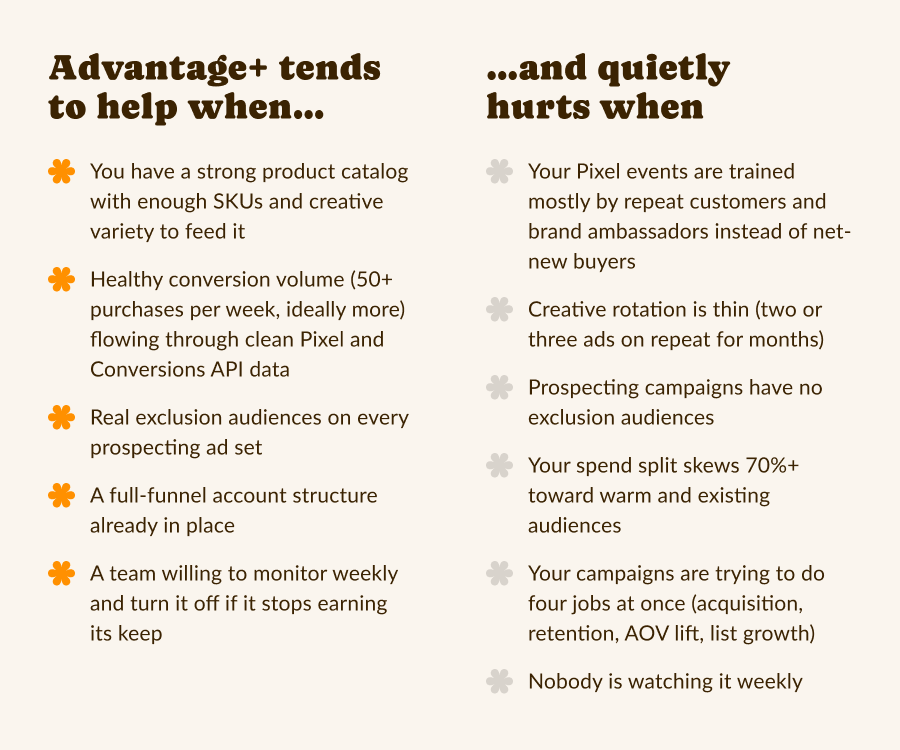
When Advantage+ helps and when it hurts
If you nodded at three or more of the second list, the issue probably isn't Advantage+. It's the data Advantage+ is being asked to work with.
The pain trigger that started this post
There's a thread on r/FacebookAds where an operator wrote: "Since enabling Advantage+, the CPCs for the winning ads have almost tripled… results almost identical to manual." You can read it on Reddit.
Reading the comments is its own education. Half of them say "Advantage+ is broken." The other half say "you don't know how to use it." Neither half asks the question that actually matters: what is the conversion event teaching the algorithm?
Search Engine Land ran a clean test of Advantage+ targeting and found it generated leads 20% cheaper than interest-based targeting, but the cost per MQL came in at nearly 2x higher. The leads were cheaper. They were also worse. (Coverage here.) Different funnel, same pattern.
The audit we run
When a brand comes to us saying "Advantage+ isn't working," we don't start with Advantage+. We start with the account. Here is the actual order.
1. Pull the audience-type spend split for the last 12 months.
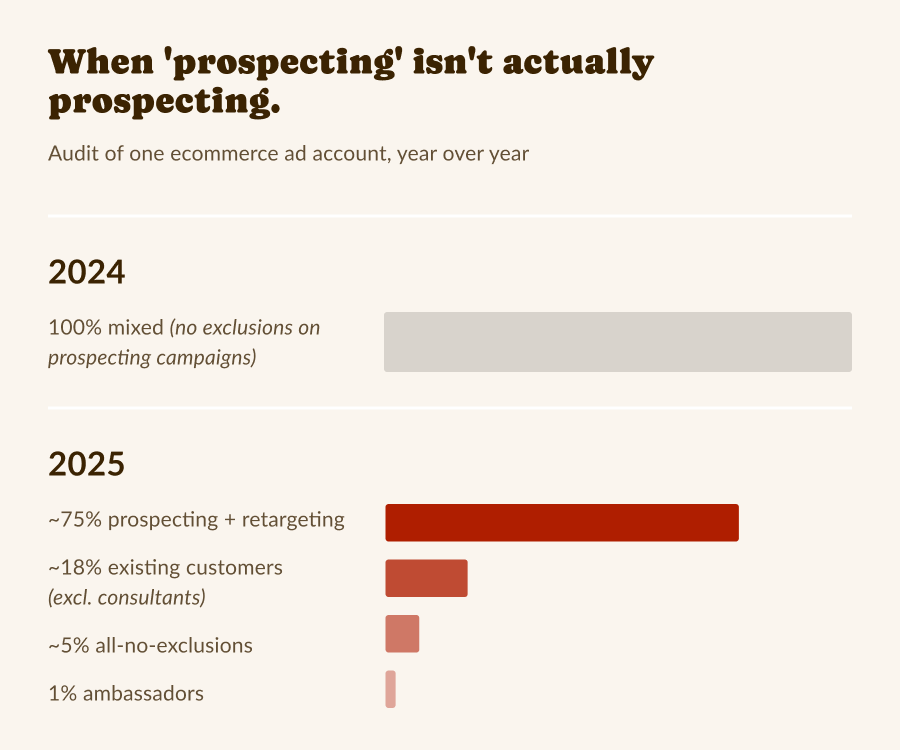
Not by campaign name. By who the campaign actually served. Ad sets with "Prospecting" in the name are constantly serving warm audiences because nobody set the exclusion audiences. This is the single biggest finding we hit in audits, and it's almost never written about publicly.
2. Confirm the conversion event hierarchy.
What event is the campaign optimizing toward? Purchase? Add to Cart? An anonymized "View Content"? When was the last time anyone reviewed the event priority order in Events Manager? If the top priority is a low-intent event, the algorithm will hunt low-intent users.
3. Audit Pixel and Conversions API health.
Event Match Quality scores, deduplication, the gap between Pixel-reported and CAPI-reported events. Pixel poisoning shows up here: staging traffic, QA hits, bots, internal team browsing. Garbage in, expensive garbage out.
4. Map the customer profile the account has actually been trained on.
Pull purchase audiences from the last 6 and 12 months. Cross-reference with GA4 demographics, the email list, and social listening. If the people Meta has been learning from aren't the people the brand is trying to acquire today, Advantage+ will keep finding more of the wrong people. That's not a bug. That's the math.
5. Inspect creative rotation and testing cadence.
How many net-new creative concepts shipped in the last 30 days? Not variants. Concepts. If the answer is two, Advantage+ has nothing fresh to test.
6. Map the funnel structure.
Is there an Awareness campaign? A Traffic campaign? A Conversion campaign with prospecting and retargeting as separate ad sets with proper exclusions? A Lead Generation campaign for top-of-funnel list growth? If there's one "Sales" campaign trying to do all four jobs, Advantage+ will pick the cheapest of the four (usually retargeting clicks) and starve the rest.
7. Define kill criteria before you turn anything on.
We set thresholds before we test. If blended CAC creeps past target by X% over Y days, we pause. If the prospecting-to-retargeting revenue ratio inverts, we pause. Without kill criteria, every test runs forever because the algorithm is "still learning."
This is the audit. It works because most accounts fail at step 1, 2, or 4, and once you fix the inputs, the Advantage+ question answers itself.
“Most Advantage+ complaints aren't Advantage+ problems. They're audience-hygiene problems wearing an Advantage+ costume.”
What this looked like for one ecommerce account
They had been leaning on Advantage+ for new customer acquisition. It wasn't working, and the reason was both obvious and easy to miss. Every conversion the algorithm had ever seen in that account came from existing customers, brand ambassadors, and longtime loyalists. Some of those loyalists had been buying from the brand for two or three decades. Their initial demographic when they started buying, a 30-year-old parent in the mid-1990s, is now a 60-year-old grandparent. The brand still wants their business, but it isn't the ICP for growth. Advantage+ wasn't acquiring new customers because the only people it had ever been trained to find were customers who had been with the brand for a generation.
The ICP they needed to reach was different: women with families, stay-at-home and busy working moms, 25 to 55, typically with two or more kids under 18. We later layered in a "busy working professional who wants a fast, healthy dinner in under 30 minutes" angle and tested a divorced-parent angle. None of those people were in the conversion data Meta was learning from.
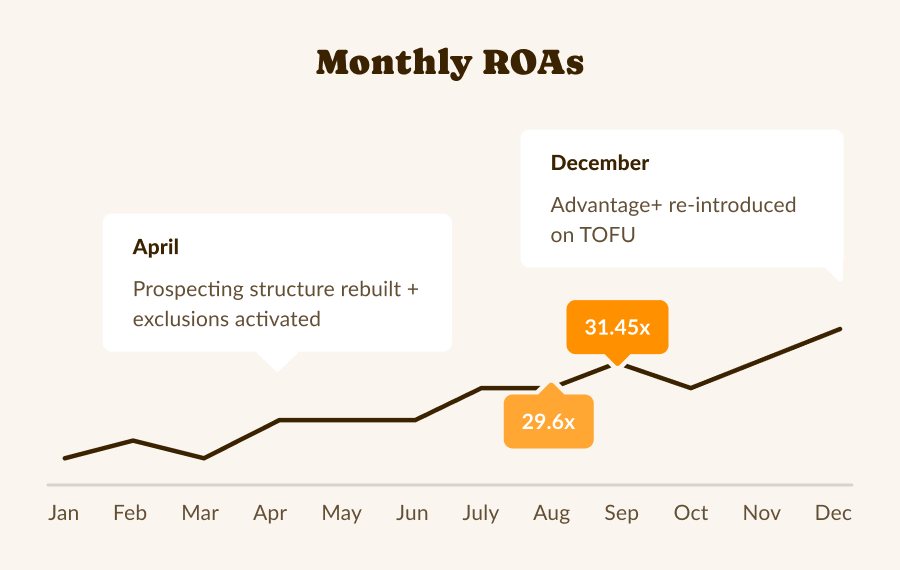
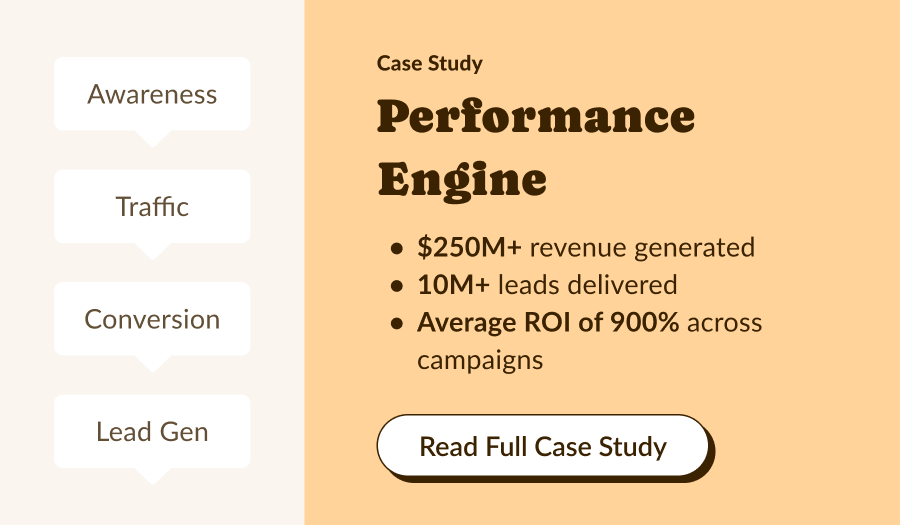
Here is what we did in the order we did it. We turned Advantage+ off. Not forever, just until the inputs were clean. We rebuilt the account structure into a full funnel of Awareness, Traffic, Conversion, and Lead Generation campaigns, supported on the Google side with mirrored intent. We activated exclusion audiences on every prospecting ad set so prospecting actually prospected. We built net-new prospecting audiences from scratch: custom audiences from clean website data, lookalikes built on clean source lists rather than the messy purchase audience, and interest stacks informed by GA4 and social listening. One example angle was a clean-eating interest cluster, which genuinely fit the product line. We tested new ICP angles like working professionals chasing a 30-minute dinner. We held creative cadence, shipping fresh concepts weekly. And then we waited. We didn't reintroduce Advantage+ for nine months. We let the new conversion data train the account first.
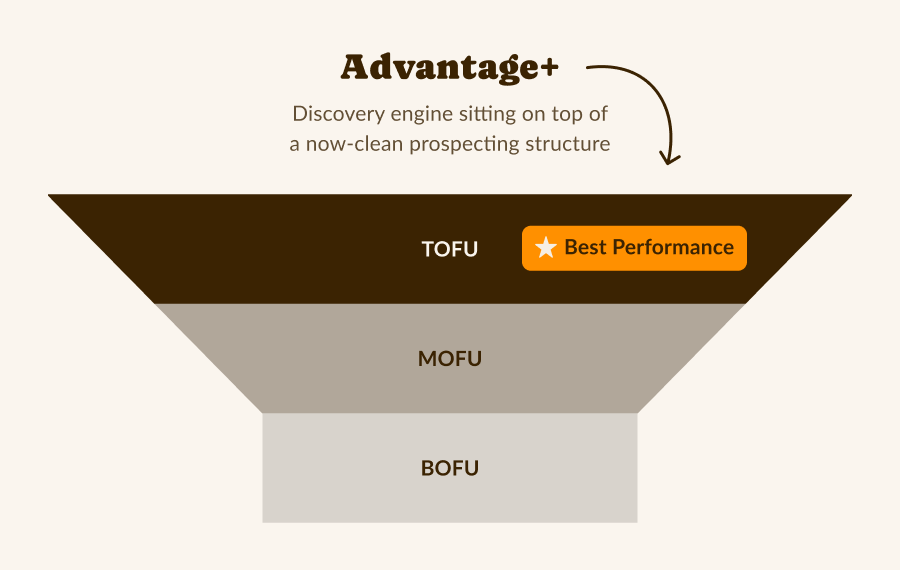
By December 2025, with clean prospecting data finally living in the Pixel, we turned Advantage+ back on, selectively. We tested it in Conversion campaigns. We tested it in TOFU and Awareness campaigns. The best performance came from TOFU. That's where Advantage+ earned its keep in this account: not as a sales engine, but as a discovery engine sitting on top of a now-clean prospecting structure.
Directional results across 2025: spend grew roughly 48% year over year because performance scaled into the budget, revenue grew roughly 54%, and Purchase ROAS held above 22x for the year with several months over 25x (August at 29.6x, September at 31.45x). The audience-spend split flipped from "almost entirely existing customers and ambassadors" to roughly 75% legitimate prospecting and retargeting structure. CAC normalized after the rebuild. The early months were noisy as the algorithm relearned, exactly as expected.
The lesson isn't "Advantage+ works." The lesson is that Advantage+ amplifies whatever signal is already in your account. Clean the signal first, then automate.
Want to see how full-funnel restructuring impacts long-term paid performance? Explore our paid media work.
When to test Advantage+ and when to leave it off
Test Advantage+ shopping campaigns when you're spending $15K+/month on Meta with healthy conversion volume, your catalog has 20+ products with feed hygiene in order, your prospecting structure already has working exclusion audiences, you have a creative cadence that can keep feeding it new concepts, and you have a measurement plan that doesn't rely solely on Meta-reported ROAS.
Test Advantage+ audience inside a Conversion campaign when you're confident your conversion data reflects your real ICP, you have a control audience (interest + lookalike) to measure against, and you have at least three to four weeks of budget to give it past the learning phase.
Leave Advantage+ off when your account is freshly restructured and the algorithm is still relearning the new ICP, when you're in a measurement window for a clean A/B test, when you're below the conversion volume threshold to exit the learning phase reliably, or when your spend split is still retargeting-heavy.
The A/B test rule we don't break
If you're running a structured A/B test on Meta, do not turn on Advantage+ Campaign Budget Optimization mid-test. ACBO will reallocate budget between ad sets based on its own optimization signal, which means the two cells of your test will end up with different spend, different audiences, and different learning-phase trajectories. You can't isolate the variable you were trying to measure. The test isn't broken. Your ability to read the test is.
This isn't a "never use ACBO" rule. ACBO is a fine tool. It's just incompatible with controlled testing. Once the test is over and you've made a decision, ACBO can take over scaling. Just not testing.
The bigger principle is short and worth keeping: you can't evaluate automation if you let the automation move the variables mid-test.
What's actually new about Advantage+ in 2026
A few honest updates if you haven't touched ASC in a year. Existing customer caps inside ASC are more granular than they were. Catalog creative enhancements (auto-music, auto-crop, auto-text overlay) are on by default; turn them off if you have a strong brand system. Advantage+ audience is baked into most campaign objectives now, with the option to provide an "audience suggestion" Meta treats loosely. And reporting clarity around incremental lift is still limited; if incrementality matters to your CFO, run a geo holdout or a third-party lift test outside Meta's walls.
None of these change the underlying logic. You're still asking a machine to scale whatever signal is already in your account.
Get the weekly take
We send a marketing newsletter called Happy Marketing. It's the marketing newsletter people actually love to read: short enough to finish over a coffee, sharp enough to be worth your time. Subscribe to Happy Marketing.
Where most teams should start tomorrow
Pick the cheapest, fastest version of this audit. Pull last quarter's spend split by actual audience served, not by campaign name. Check the exclusion audiences on every prospecting ad set. Pull your top 100 purchasers from the last 90 days and compare them to the ICP you say you're targeting. Count the net-new creative concepts shipped in the last 30 days. Confirm your Pixel and Conversions API are deduplicating cleanly.
If any of those return something ugly, fix that before you decide whether Advantage+ is working. The fastest way to make automation look good is to give it good inputs.
.png)
If you want help with the audit, book a strategy call. We'll tell you exactly what we'd change in your account. If we're a fit, we'll talk retainer. If we're not, you'll still walk away with an audit with recommendations you can use.