Most founders we talk to have been burned twice. Once by a freelancer who went quiet right when a campaign was supposed to launch. Once by an agency that took six weeks to ship a landing page nobody loved. By the time they're on a call with us, they're not really asking "agency or freelancer." They're asking "is there anyone who will actually move."
This post is the answer we wish more founders heard before they signed the next contract. We'll name the real reasons both options fail, the questions to ask whoever you hire next, and the conditions under which each model actually works.
If you'd rather skip the read and talk through your situation, book a strategy call. Otherwise, scroll on.
Why this debate is framed wrong
Search "marketing agency vs freelancer" and you get three flavors of content, and all three are bad. There's agency-written content that argues agencies are better, which founders can smell from orbit. There's marketplace content that argues freelancers are better, which is the same trick in reverse. And there's a swamp of "it depends" listicles that refuse to take a position at all.
None of them name the operational reality. Founders aren't choosing between agencies and freelancers. They're choosing between two failure modes. And the smart question isn't "which is better in the abstract." It's which failure mode is fixable.
The two failure modes
The freelancer failure mode
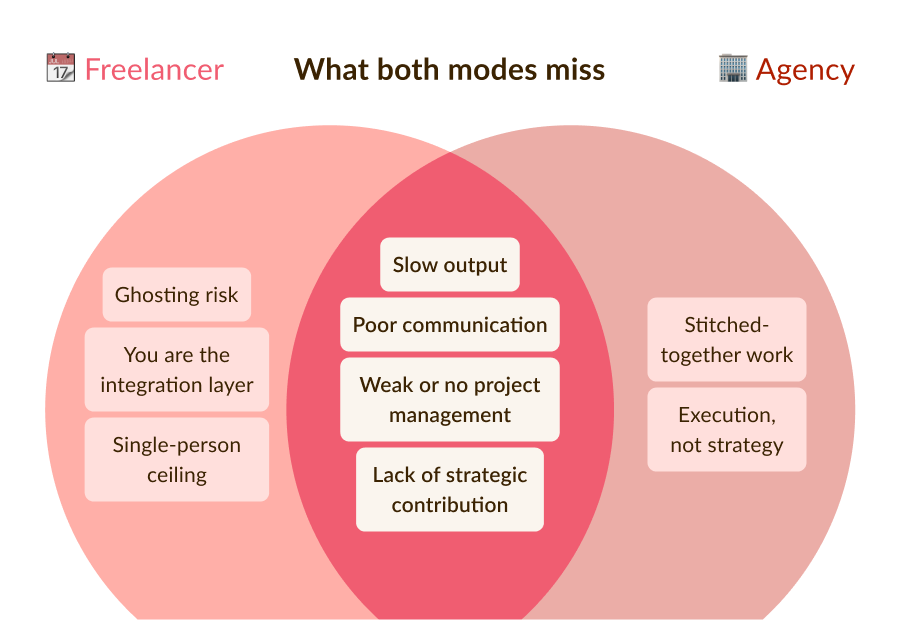
A freelancer is one person with one calendar and one set of skills. When the work is going well, that's elegant. When it isn't, the failure patterns are predictable. Output is slow because a single human is queueing your work behind everyone else's. The freelancer can ghost when they get sick, get a full-time offer, or take on a bigger client. There's no backup. Strategic contribution is usually thin because most freelancers are paid to execute, not to push back, so you end up writing the brief, the strategy, and the campaign plan, then handing it off and waiting. The most expensive part isn't the invoice. It's the part where you, the founder, become the integration layer for five contractors who don't talk to each other. You're the only person who knows what the SEO contractor told the paid contractor told the email contractor. That role doesn't show up on any invoice until you burn out or strategy drifts.
The agency failure mode
An agency has more people, which sounds like an upgrade until you meet the agency. Communication can crawl. Slack messages get answered in three-day chunks. Weekly check-ins produce a status update and not much else. Output is slow for the same reason a freelancer's is, just with extra layers: your account manager waits on the strategist, who waits on the copywriter, who waits on the designer, who waits on a review cycle. There's often no real project management. No shared tool. No visible board. No accountability to milestones. You can't see what's happening between calls. The work feels stitched-together because the agency's "team" doesn't talk to each other internally any more than your freelancer stack did. And strategic contribution is often missing here too. You get execution against a brief you wrote, not a partner who pushes back or contributes.
What both modes share
Look at the failure lists side by side and the overlap is uncomfortable. Both can be slow. Both can communicate poorly. Both can lack project management. Both can fail to contribute strategically. The difference is which problems are structural and which are fixable.
The freelancer's failures are structural. Capacity, single-person ceiling, no backup, ghosting risk: those don't get solved without that freelancer becoming, well, an agency. The agency's failures are operational. Slow communication, weak project management, disconnected team members, no strategic contribution: those are all fixable. They're fixable by an agency that runs differently. The problem is that most don't, which is why the average agency engagement leaves founders feeling like they paid for a freelancer with more chairs.
“Founders aren't choosing between agencies and freelancers. They're choosing between two failure modes. The smart question is which one's fixable.”
When freelancers actually win
We're not anti-freelancer. We've been the freelancer side of this for our own clients' clients. Freelancers genuinely win in four situations, and if you're in one of them, hire one and don't overthink it.
The first is when you already have a marketing leader in-house to direct them. A freelancer with a strong director on top is a great combination because the integration problem is solved by the director.
The second is when your scope is narrow and single-channel. If you need a Google Ads specialist for one campaign type, you don't need a full-service partner. You need that specialist.
The third is when you're testing a channel before committing. Hiring an agency to test TikTok ads is overkill. A specialist freelancer for 60 to 90 days will tell you whether the channel is worth a real investment.
The fourth is when you need a specialist nobody on staff can replace, like a domain expert who's spent a decade in one platform. That's a hire you make for the depth, not the breadth.
Outside those four scenarios, the freelancer stack usually creates more management work than it removes. Hence the founder-as-integration-layer problem.
What to demand from an agency: the 5-question vetting scorecard
If you're going to hire an agency, the bar is higher than "they have a deck and an account manager." Here are the five questions to ask before you sign. Each one targets a specific operational failure mode. If they fumble any of them, walk.
1. What's our shared project management tool, and can I see active boards from current clients with names redacted?
Why this matters: a project management tool is the single best proxy for whether an agency actually operates as a team. If they can't show you a board, they don't have one. If they have one but won't share a redacted view, you're getting opacity instead of operations.
What good looks like: a real tool (Asana, ClickUp, Monday, Notion). Active boards with tasks assigned to named people. Status updates that aren't from yesterday. A willingness to add you as a guest on day one so you can see your work move in real time.
2. What's the communication cadence, and what's guaranteed in writing?
Why this matters: most agency frustration is communication frustration. "We meet weekly" is not a cadence. It's a calendar invite. A real cadence is response-time commitments, async update commitments, and a defined escalation path when something is on fire.
What good looks like: a written cadence in the SOW. Slack or shared channel response within a defined window. Weekly written async updates between live meetings. A named human you can reach when something breaks.
3. Who specifically will be on my account, and will I meet them on the kickoff call?
Why this matters: the people in the pitch are often not the people doing the work. This is the oldest agency tell in the industry. If the senior strategist who wowed you in the sales call disappears after week two, you've been bait-and-switched.
What good looks like: named people on the SOW with their actual responsibilities. A kickoff call where you meet the strategist, the copywriter, the designer, and the account lead, by name. A clear answer to "if person X is sick or on vacation, who picks up the work?"
4. What's a realistic timeline for our first three deliverables, and what are you doing in week one?
Why this matters: a vague answer here is a tell. Agencies that are slow are slow because they don't know what they're doing first. Agencies that are fast can sketch out the first 30 days on a napkin.
What good looks like: specific deliverables with specific dates. Week one isn't "discovery." Week one ships something, even if small. A workback timeline that you can hold them to.
5. When you push back on my strategy, what does that look like?
Why this matters: the difference between execution and partnership is whether the agency tells you when you're wrong. Founders who hire agencies that only nod end up paying for prettier execution of bad ideas.
What good looks like: a real example of a recent moment when the agency told a client "we don't think this is the right move, here's why." If they can't think of one, they aren't a strategic partner. They're a vendor with deliverables.
If you ask those five questions to whoever you're considering, the right partner gets clearer fast. We answer all five of those questions on our discovery calls, which is the polite version of saying: if you're vetting us, vet us on those.
What this looks like in practice: a B2B SaaS engagement
Here's how this plays out with one client, anonymized.
A B2B SaaS company in the mobile and electronics resale market came to us in early 2026. Lean team of three. The product is excellent and the founders are deep operators. Marketing had been founder-led for most of the company's history, with stints of freelancer help and an agency engagement, neither of which produced enough value to keep. The founder's own description on our kickoff call was that he was "context switching so much" between sales, product, support, and marketing that consistency was impossible.
The pattern was familiar. Plenty of new features and integrations launching, very few campaigns going out. When campaigns did go out, they were text-only product update emails with a Loom link. No multi-channel coordination. No campaign calendar in the company's history. No release-note pipeline. No sales enablement docs. Just a founder doing their best on top of everything else.
We started narrow on purpose. The original engagement was a 90-day experiment focused on getting consistent product-update campaigns out the door across email, LinkedIn, WhatsApp, and Intercom. The founder's framing on the kickoff: "if all else failed, doing this is my absolute goal."
The first campaign shipped inside the first month, which sounds basic until you remember that consistency was the original ask. The next campaign added an in-house motion animation in place of the Loom video, which the founder asked us to make the new default after seeing the first one ship. The campaign calendar moved into Asana, shared with the client team, so every campaign had a workback timeline visible to everyone. Release notes started moving from a sign-in page footnote into a real pipeline that fed the campaign engine.
Six weeks in, the engagement was already expanding. The founder asked us to take on conference and tradeshow video work. Booth design and event collateral got added to the scope. We started exploring a landing page test that turns "book a demo" into "tell me more" for top-of-funnel leads who aren't ready for a calendar invite. Custom in-product Intercom campaigns folded into the retainer rather than living as a per-campaign add-on. The conversation on our most recent call started shifting toward SEO, CRO, and sales enablement, none of which were in the original scope.
The directional results so far: warmer prospect conversations off the back of the new campaign cadence, and a real lift in upsell and expansion conversations with the existing customer base, which is exactly what should happen when a SaaS product communicates consistently to people who are already paying. The founder is on the record saying he wants to add a case study to the engagement once we cross the three-month mark.
The lesson isn't "and that's why agencies are better." The lesson is what kind of agency. They tried a freelancer. They tried an agency. Both ended. What was different this time wasn't that we're an agency. It was that we operate the way the 5 questions above demand: a shared Asana board with the client embedded as collaborators, defined response cadences, named team members on the account from day one, real campaign timelines, and a strategy contribution loud enough that the founder reshaped half the engagement in week three based on our recommendation.
The same pattern shows up in the paid-media accounts we audit, where Advantage+ campaigns get blamed for problems that are actually audience-hygiene problems. We wrote about that here. The shorter version: the model isn't usually the issue. The operations are.
What integrated marketing actually means (and why neither freelancers nor most agencies deliver it)
The phrase "integrated marketing" gets used a lot and earned almost never. Here's the operational definition we use: every channel reinforces the other channels because they're planned, briefed, and shipped together from one calendar.
What that looks like in practice: when a new feature launches, the email, the LinkedIn post, the WhatsApp share, the in-product Intercom banner, the sales enablement note, and the website update all ship from the same brief and the same campaign card. They reference each other. They use the same hero. They reuse the same animation. Nothing is one-and-done because every asset gets multi-purposed by design.
A freelancer stack can't do this. Each freelancer owns one channel, writes their own brief, and rarely talks to the other freelancers. The integration job falls back on the founder, which is exactly the failure mode we already named.
Most agencies don't deliver it either, because most agencies are structured as channel pods. The paid media team doesn't talk to the email team. The content team writes for the blog. Nobody owns the campaign as a unit. You get parallel execution, not integrated marketing.
The version that actually works requires three things: one shared campaign calendar with the client embedded in it, one strategist who owns the campaign across channels, and a content engine that treats every asset as multi-channel from the brief stage forward. Most agencies don't do this. The ones that do are the ones worth paying for.
If you want the framework we use to plan integrated campaigns for SaaS clients, that's what the B2B SaaS Marketing Playbook is for. Free download, linked above.
Where most founders should start tomorrow
Before you hire anyone, do a quick honest audit. Open a doc. Write down the names of every external person currently doing marketing for you. Next to each name, write the channel they own, the last time they shipped something, and the last time they pushed back on your strategy. If most of the "last time they pushed back" column is blank, you don't have a marketing partner. You have a queue of execution.
If you decide a freelancer is right, hire one with a clear scope and a clear marketing leader to direct them.
If you decide an agency is right, ask the 5 questions before you sign. Walk if they fumble. The right partner gets clearer fast when you make them earn it.
We're not going to tell you to hire us. We're going to tell you to hire whoever answers those 5 questions credibly. If that ends up being us, great. If it ends up being someone else, the post still did its job.
What this looks like in practice: a B2B SaaS engagement
We send a marketing newsletter called Happy Marketing. It's the marketing newsletter people actually love to read: short enough to finish over a coffee, sharp enough to be worth your time. Subscribe to Happy Marketing.

If you'd like a second pair of eyes on your current setup, book a strategy call. On the call, we'll tell you exactly what we'd change in your marketing operation. If we're a fit, we'll talk retainer. If we're not, you'll walk away with a real audit either way.