Every founder we talk to has done some version of this math on the back of a napkin.
"If we just hired a VP of Marketing, then a content person, then a paid person, we'd be running."
The math on that napkin is almost always wrong. Not because the salaries are off by a little, but because the napkin is missing entire line items. Benefits. Payroll tax. Software. Training. And the line that breaks most plans: the working budget you need to actually run the marketing once the team is hired.
This is the real 2026 number for a B2B SaaS company trying to staff a full content, paid, and email engine in-house. Then it's the math on what a fractional team actually replaces, and the two functions we tell every client they shouldn't outsource no matter how lean they're running.
If you've ever opened a planning doc, typed "Hire VP Marketing" at the top, and felt the room go quiet, this is the post.
The five roles you'd actually need
A real in-house B2B SaaS marketing engine, at the level a Series A company needs to compete, is not one VP and a content writer. It's five distinct roles, and skipping any of them means the engine misfires.
1. CMO or VP of Marketing
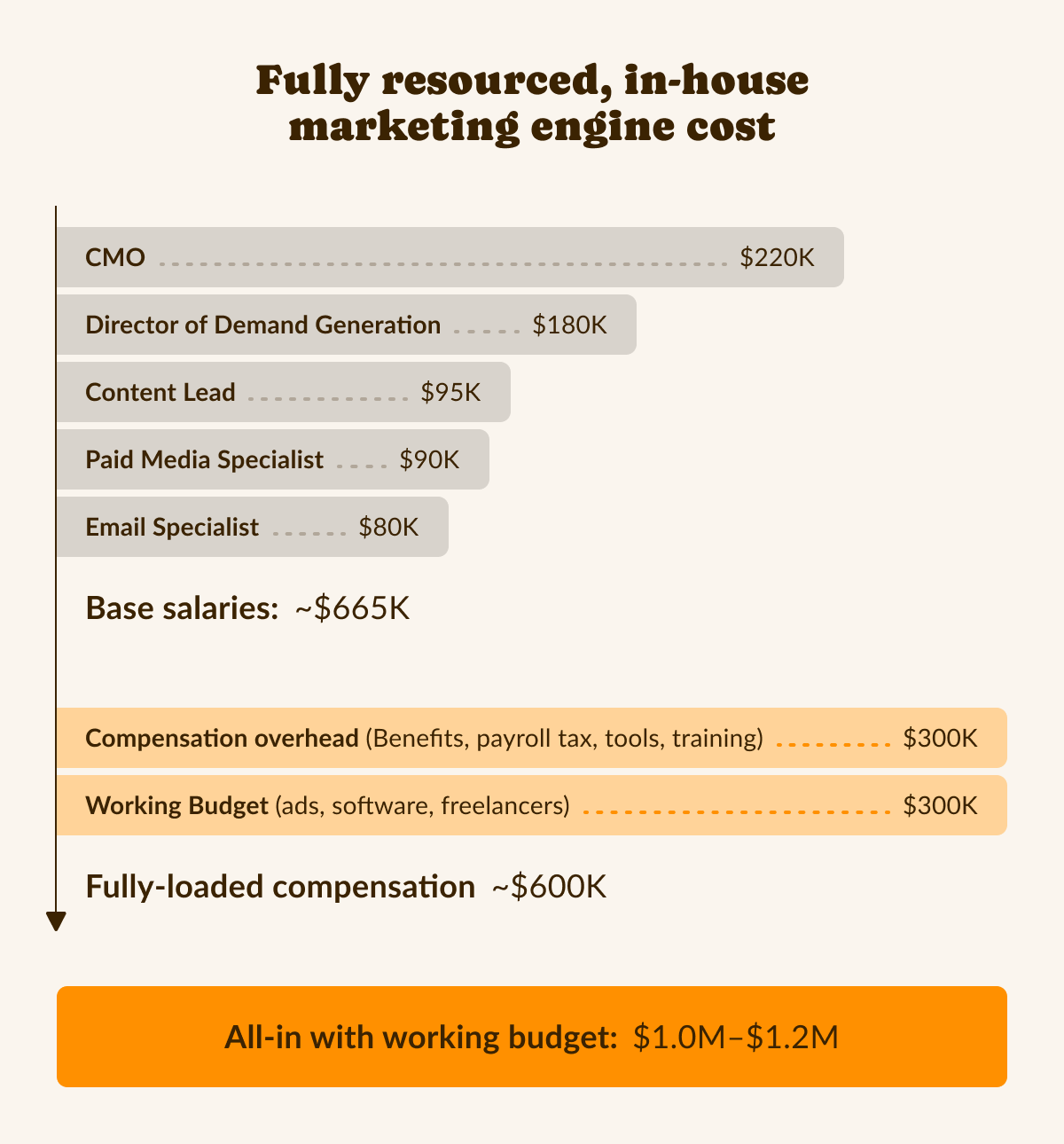
Owns strategy, narrative, hiring, board-level reporting, and cross-functional alignment with sales and product. 2026 senior B2B SaaS comp: roughly $220K base.
2. Director of Demand Generation
Owns the funnel. Paid acquisition strategy, MQL-to-SQL conversion, attribution, and the integration between marketing ops and sales. 2026 comp: roughly $180K base.
3. Content Lead
Owns the editorial calendar, SEO strategy, the actual writing on the highest-stakes assets, and the relationship with subject matter experts inside the company. This is the core of your content marketing execution. 2026 comp: roughly $95K base.
4. Paid Media Specialist
Owns the day-to-day inside Meta, LinkedIn, Google, and whatever channels you're testing. Builds campaigns, manages paid acquisition strategy, reports on performance . 2026 comp: roughly $90K base.
5. Email and Lifecycle Specialist
Owns the lifecycle program: welcome flows, nurture sequences, product announcements, churn-prevention. For B2B SaaS this person is also writing inside HubSpot or Customer.io daily. 2026 comp: roughly $80K base.
Add those up and you're at $665K in base salaries before anyone has done any actual marketing.
The line items that aren't on the napkin
Base salary is the smallest number in this conversation. The full cost of an in-house marketing team has three layers, and most founders only price the first one.
Layer one: compensation overhead.
Employer payroll tax, health insurance, 401(k) match, equity, PTO, professional development, recruiting cost amortized over the role. The industry rule of thumb is roughly 30% on top of base. On a $665K salary stack, that's another ~$200K. Fully-loaded compensation is closer to $865K.
Layer two: tools and software.
HubSpot or Marketo enterprise tier. SEO software (Ahrefs or Semrush). Analytics. Attribution. Design tools. Project management. Asset libraries. A real B2B SaaS marketing stack runs $3K–$8K per month depending on company size, which is another $40K–$100K per year.
Layer three: the working budget.
This is the line item that ends most in-house marketing plans before they start. Once you have the team, you still need the money to do anything with it. Paid media spend. Sponsored content. Freelance video editors. Photography. Influencer fees. Events. A real working budget for a Series A B2B SaaS doing serious demand generation is $150K–$300K per year, and that's on the lean end.
Stack it all together and a fully resourced, in-house marketing engine for a B2B SaaS company in 2026 costs roughly $1.0M to $1.2M per year, all-in.
That is the real number. Not the napkin number.
"But our meta says $525K"
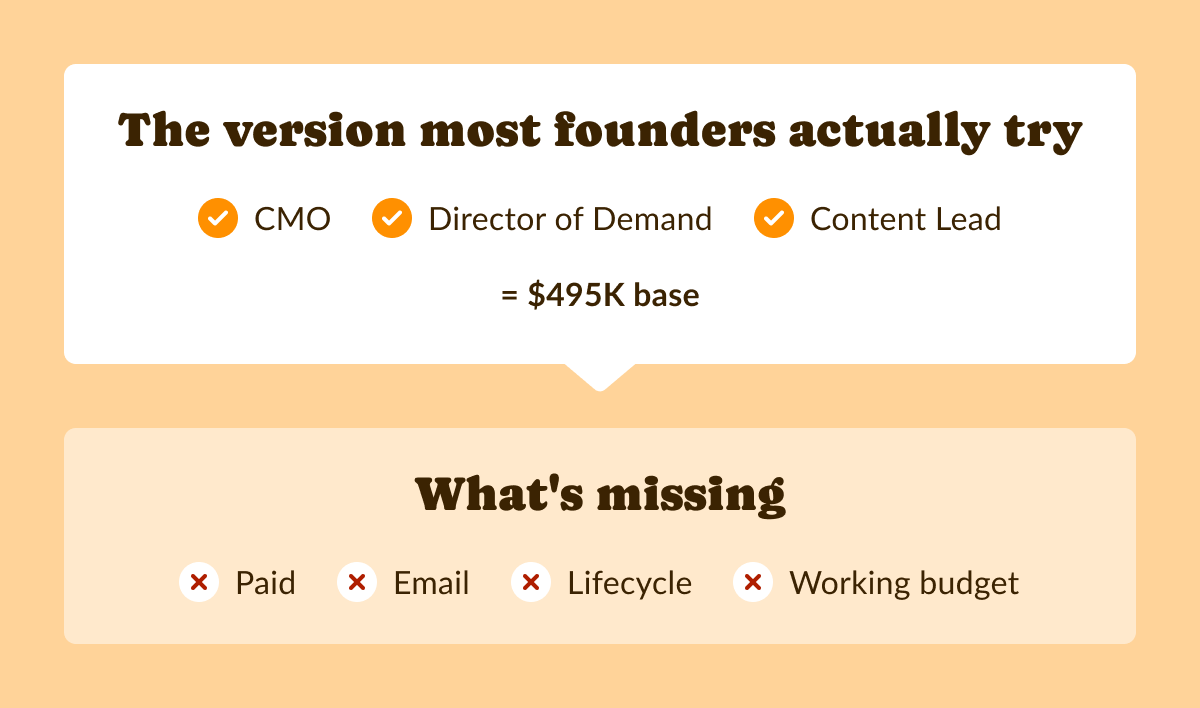
If you've ever poked around our site you've seen us reference $525K as the cost of an in-house marketing team. That number is real, but it's a specific cut of this math, and it's worth being honest about which version of the team it represents.
$525K is what you get when you staff a stripped-down version of the in-house stack: a CMO, a Director of Demand, and a Content Lead, with light overhead and no specialists for paid or email. It's the version most founders actually try. And it's the version that almost always stalls within nine months, because the three people you hired can't also be the paid specialist, the email specialist, and the lifecycle owner.
$525K buys you three excellent generalists who will spend most of their time covering for the two specialists you didn't hire, while you keep wondering why the pipeline doesn't compound.
Both numbers are honest. The $525K is what most founders try first. The $1.0M+ is what it actually costs to finish building the team.
What a fractional team replaces
A fractional B2B SaaS marketing team at our retainer level, $7K to $10K per month, replaces the operating capacity of that five-role in-house stack. Strategy. Content. Paid. Email. Lifecycle. Reporting.
Annualized, that's $84K to $120K for a team that ships marketing every week instead of a team you're still hiring eight months from now.
It does not replace the working budget. You still need ad spend. You still need software (though we bring our stack to most engagements, which saves you the procurement cycle). You still need to pay for the things marketing pays for.
But you do not need to carry $865K in fully-loaded compensation for a team that, in the first year, is mostly going to be hiring, onboarding, and getting their tools set up.
The math we run with most pre-Series B SaaS clients looks like this:
- Fractional team retainer: ~$100K/year
- Working budget (ads, software, freelancers): $150K–$300K/year
- One strategic in-house hire kept or made later (we'll get to this): $120K–$180K/year
All-in: $370K to $580K per year for an engine that's actually running campaigns, instead of $1M+ for an engine that's still being built.
“Most pre-Series B SaaS founders are not choosing between in-house and fractional. They're choosing between an in-house team they can't actually afford to staff, and a fractional team that does the same jobs without the burn.”
The two functions we tell every client they shouldn't outsource
This is the part most agency content gets wrong. A fractional team should be honest about what it cannot replace, and we are aggressive about saying this out loud on sales calls.
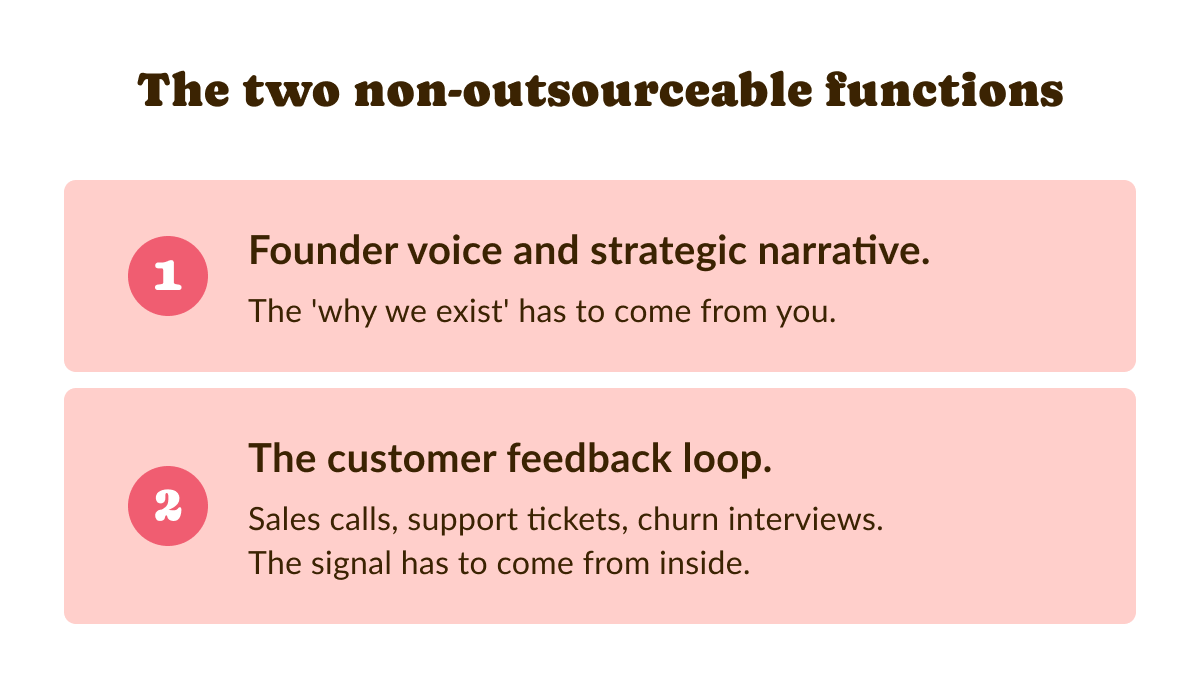
One: the founder voice and strategic narrative.
Why your company exists, what you're betting against, the conviction that makes your point of view defensible. We can package it. We can pull it out of you in a workshop. We can write to it in your tone of voice. We cannot manufacture it. Founders who try to fully outsource their strategic narrative end up with marketing that reads like every other vendor in the category, and they wonder why pipeline is soft.
Two: the customer feedback loop.
Sales calls. Support tickets. Churn interviews. Win-loss debriefs. The product signal that tells you what messaging actually lands and which features matter. That signal lives inside the company, and the people closest to it are sales, support, and product, not marketing. A fractional team can analyze it, synthesize it into messaging, and reflect it back as campaigns. But if the loop isn't running on the inside, there's nothing for us to listen to.
This is why our healthiest engagements have one strategic in-house anchor: a founder, a head of sales, or a director of marketing who owns the voice and the customer signal, while our team owns the execution.
“A fractional team can package your story. We can't manufacture it. The founder voice and the customer signal have to live inside the company.”
What this looked like for one Series A SaaS
A B2B SaaS client that came to us had done the napkin math the same way every founder does. They were eleven months past their Series A, and they'd hired a Director of Demand Generation and a Content Lead in-house. Two strong hires, both senior, both expensive. Combined fully-loaded comp: roughly $420K.
Eleven months in, the board started asking why the pipeline wasn't compounding. The honest answer was that the two people they hired were excellent at strategy and writing, but they were spending most of their time trying to also be the paid specialist, the email specialist, the designer, and the marketing ops person. The campaigns shipped were good. There just weren't enough of them, because two people can't run a five-role function.
When they brought us in, the math changed in three ways.
They kept the Director of Demand as the strategic in-house anchor, the person who owned the voice and the customer signal. They moved the Content Lead off full-time and into a part-time advisory role on the highest-stakes pieces. Our team picked up the paid, email, lifecycle, and weekly content cadence on a fractional retainer.
Fully-loaded annual marketing cost moved from roughly $700K with most of it sitting in salary to roughly $450K with most of it sitting in working budget and campaign output. Campaigns shipping per month went from two or three to a weekly cadence. The Director of Demand stopped trying to be five people and started doing the strategic work she'd been hired for.
The point of this story is not that fractional is always cheaper. It's that the napkin math founders run almost never reflects the working budget, the specialists, or the time-to-productivity for new hires. When you put all of it on one page, fractional usually wins for pre-Series B SaaS, and the founders who try in-house first almost always end up here anyway. The cheaper path is to do it second.
How to think about your own math
If you're a founder reading this and trying to figure out which side of the line your company sits on, three questions usually settle it.
One. Can you commit to $1M+ per year in fully-loaded marketing cost for the next 24 months?
Not the salaries. The all-in number with overhead, tools, and working budget. If the honest answer is no, in-house is not the right call yet, and the fractional path will get you further on the budget you actually have.
Two. Do you have a strategic in-house anchor already?
A founder, a head of sales, or a director-level marketer who owns the voice and the customer signal. If yes, a fractional team has someone to plug into. If no, hire that one person first, and bring in a fractional team to execute around them.
Three. Are you trying to compound a pipeline, or are you trying to build a marketing department?
These are different goals. A fractional team is built to compound pipeline. A full in-house team is built to scale a department, which is the right move post-Series B with a meaningful working budget and a CMO to lead it.
If the answers point toward fractional and you want to see what the math actually looks like for your specific stage, role plan, and working budget, that's exactly what the calculator below was built for.
The B2B SaaS Marketing Playbook
If you want the operating system behind how a fractional team replaces a $500K to $1M in-house stack, the full integrated approach lives in our B2B SaaS Marketing Playbook. It's the same framework we run for every B2B SaaS client, from pre-seed founders building their first marketing motion to Series B teams replacing a CMO who left.
The honest summary
The real 2026 cost of an in-house B2B SaaS marketing team is $1.0M to $1.2M per year all-in, not the $525K most founders price into their plans.
A fractional team with one strategic in-house anchor and a real working budget runs $370K to $580K per year, ships marketing every week, and gives the founder back the time they were going to spend hiring and onboarding for the next nine months.
The two functions we will never tell you to outsource: the founder voice, and the customer feedback loop. Everything else, we can run.
If you're somewhere on this curve, what to demand from any marketing partner is the next post worth reading. So is the same pattern shows up in Meta ad accounts.

Or if you want to run the numbers for your specific stage and role plan, book a strategy call. We'll walk through your napkin math, your working budget, and what a fractional team would actually cover for you. Book a strategy call.